
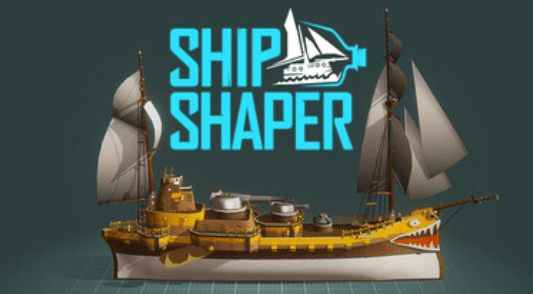
Some games earn their depth slowly. You chop trees, you build a base, you defend it, and forty hours later you remember why you started. ShipShaper wants none of that. You open it, you see a hull, you pull on it, and within a minute you have something that is recognisably a boat and entirely yours. That is the whole pitch. After a week with the ShipShaper demo I think it might be enough.
ShipShaper is the new project from Tomas Sala, the solo developer behind The Falconeer and Bulwark: Falconeer Chronicles, published by Wired Productions. It enters Steam Early Access on 2 September 2026, and a free demo has been on the store since February. If you have ever lost an evening to a character creator while the actual game waited unplayed, this preview is for you.
What ShipShaper is, and who is making it
The elevator pitch fits in one line: a creative game about the simple joy of designing ships, nothing more and nothing less. No combat, no economy, no management layer telling you your dock is unprofitable. You shape vessels, you look at them, you share them.
The name behind it matters here. Tomas Sala is a BAFTA-nominated Dutch developer who came up through modding, where his Skyrim expansion Moonpath to Elsweyr built a reputation long before he had a commercial game. The Falconeer turned that sensibility into a full release, and Bulwark: Falconeer Chronicles refined his particular talent for building systems that feel like modelling clay rather than spreadsheets. ShipShaper began life as a small tool for Bulwark players who wanted to design their own vessels, and it grew into a standalone product when it became obvious that the shaping itself was the fun part.
Wired Productions is publishing, which continues a partnership that stretches back seven years to The Falconeer. That stability matters for an Early Access game. This is not a first-time dev betting the house on a wishlist campaign; it is an established pairing doing their fourth project together, and the demo already reflects thousands of hours of iteration.
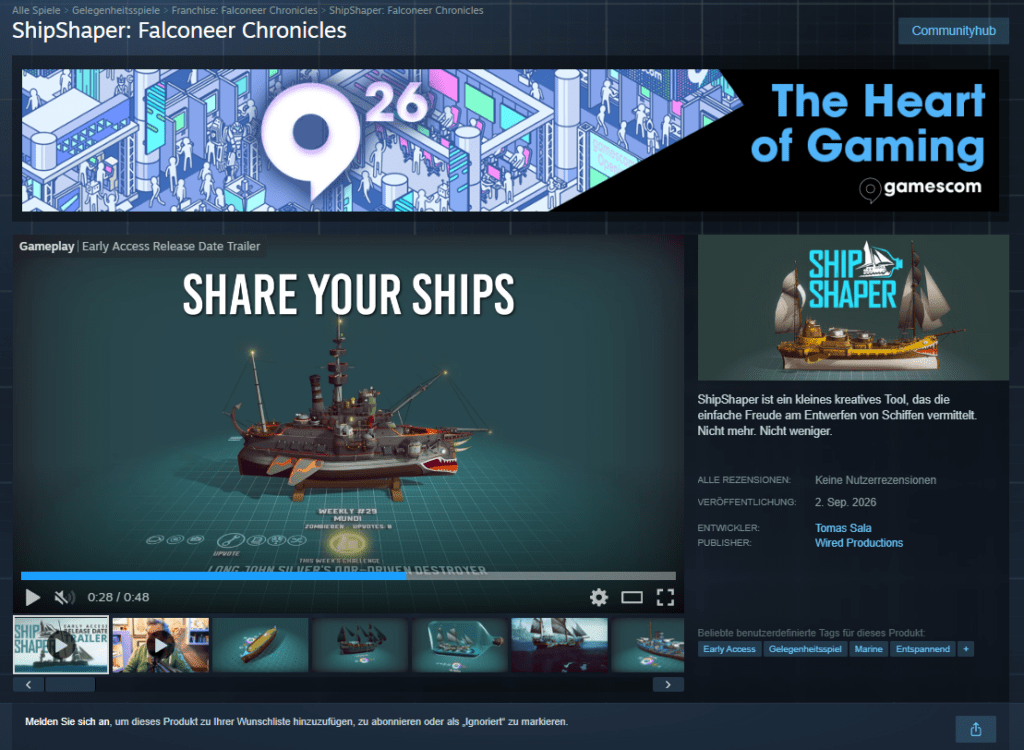
You can see the current state of it yourself on the ShipShaper Steam page, where the demo sits right next to the wishlist button.
How building a ship actually feels
The tools are deliberately crude in the best sense. You pull, push, bend and drag forms until a hull appears. There is no grid snapping you back into line, no correct answer the game is quietly grading you against, and no intimidating 3D suite menu with four hundred buttons. If you have tried Blender and bounced off it within an hour, that is the audience this design is speaking to.
What comes out of those tools spans a surprising range. The demo scenes include humble fishing vessels, tall ships with full rigging, pre-dreadnought era ironclads, and submarines. Sala has said in interviews that he loves all of it, the elegant and the monstrous alike, and the toolset does not judge. A lopsided tugboat with an outsized funnel is as valid an output as a clipper.
I spent my first session trying to recreate a harbour tug I once drew in a school notebook, and the pull-and-bend workflow got me surprisingly close before I understood half the tools. My second session produced something no shipyard would ever approve, a cross between a corsair frigate and a bathtub, and it remains my favourite thing I have made in a game this year. That is the loop. There is no failure state in ShipShaper because there is no objective to fail at.
If you like builders that respect your time and skip the survival filler, this sits in a similar comfort zone to the cozy colony building of Star Trek: Outposts Unknown, but with even less friction. Where that game still asks you to feed colonists, ShipShaper asks nothing at all. It is closer in spirit to the object painters and garden dollhouses of the world, and it knows it.
What the Early Access launch adds
The demo is a taste. The Early Access version arriving on 2 September is the real first course, and the feature list Wired has announced reads like a direct response to what demo players asked for.
The big one is water. Finished creations can be taken out of the shipyard and sailed, which turns every design decision into something you can feel. A hull you stretched too far will tell you about it the moment it has to move. Alongside sailing come new propulsion options, new sail types, historical weapons and turrets for the decoration-minded, lighting, props, and more flexible shaping tools for the hulls themselves.
Steam Workshop support means the community side is planned as a first-class citizen, and the game already ships with cloud saves and leaderboards for the challenge-minded. Exactly what those leaderboards rank remains to be seen; the announcement material does not oversell it, which I appreciate.
The roadmap is explicitly community-driven. Sala runs a dedicated channel on his Discord where historical additions and quality-of-life requests get argued about, and several features in the Early Access build grew directly from that channel. If you are the kind of player who wants a say, that door is genuinely open. The announcement press release quotes him saying the magic happens when players make something he would never have thought of, and the demo’s most-shared creations support that.
The export license is the interesting part
Here is the feature that separates ShipShaper from every other creative toy I have used: what you build leaves the game, commercially, for free.
Three export paths exist. You can bring your vessels directly into Bulwark: Falconeer Chronicles, which is a lovely loop for owners of both. You can prepare models for 3D printing using external software, so your fleet can stand on a shelf. And you can take the complete 3D model into any other creative project under a free commercial licence that covers personal and commercial use alike.
Read that last part again, because it is nearly unheard of. Most game EULAs assert that everything made in the tool belongs to the tool’s owner, or they gate commercial use behind a paid tier. ShipShaper’s licence instead lets developers, modders and makers ship its output in products they sell. According to the publisher, models from the demo are already appearing in small independent games.
For a solo artist like Sala this is also smart business. Every ship exported into someone else’s project is advertising that cost him nothing, and it recruits a small army of creators who now have a stake in the tool’s survival. It is the same open instinct that made his Skyrim mod career possible in the first place. I have watched a lot of publishers treat user creativity as a legal risk to be fenced off; this is the opposite bet, and I hope it pays off.
Bottles, dioramas and photo mode
Not every creation needs to sail anywhere. The display side of ShipShaper is its own miniature hobby: finished ships can be placed inside decorative bottles or arranged in handcrafted dioramas, and a photo mode exists for capturing the result.
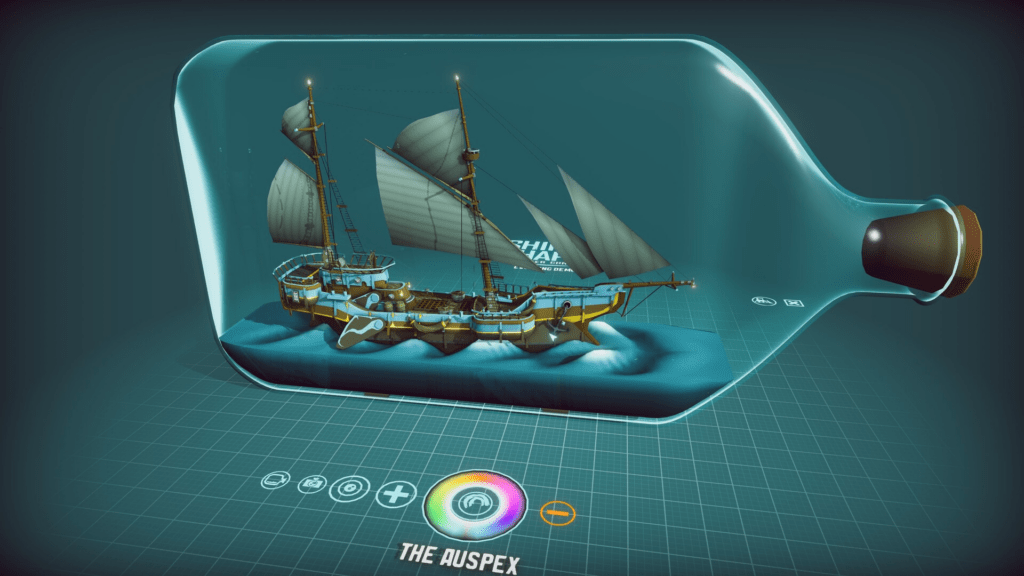
The ship in a bottle is the perfect mascot for the whole project. It is the classic impossible hobby object, the thing that makes people lean closer at flea markets, and here it is a two-click operation. There is something quietly funny about bending an ironclad into existence with your mouse and then shrink-wrapping it into nautical kitsch, and the game absolutely knows that.
Early Access expands this side too, with more props and lighting options for the dioramas. If the shaping is the craft, the bottling is the payoff, the moment your build stops being a project and becomes a thing you own.
Who ShipShaper is for, and who should wait
You are the target audience if any of the following describe you: you have hundreds of hours in character creators, you build in games to relax rather than to win, you like ships and naval history even a little, or you want a source of 3D models you can legally use in your own work. At that point the free demo answers every remaining question at zero cost.
You should probably wait if you need goals, combat or progression to enjoy yourself. Nothing in the announced feature list suggests ShipShaper is sneaking a campaign in later. The weapons arriving in Early Access are historical dress-up for your hulls, not the start of a naval combat game. And if you are allergic to Early Access as a concept, note that this one starts from an unusually strong position, a polished demo that has been public for six months, an experienced developer, and a publisher partnership with a track record, but it is still a version one point zero of a long voyage.
Pricing has not been announced at the time of writing. Wishlist ShipShaper, play the demo, and let the 2 September launch make its own case.
Verdict: try the free demo before the September launch
I went into the ShipShaper demo expecting a pleasant little toy and came out genuinely fond of it. ShipShaper commits to a single pleasure and polishes it instead of padding it. The tools are approachable enough that my first boat happened within minutes, the ceiling is high enough that I am still finding shapes a week later, and the export licence gives the whole thing an afterlife outside the game that almost no creative title offers.
The honest comparison is not to other ship games, of which there are few, but to the feeling of a box of modelling clay. Some people walk past that box forever. Some people cannot stop touching it. The free demo tells you which one you are in about ten minutes, and the Early Access build on 2 September will be there either way, with sails, propellers and an unreasonable number of historical turrets waiting for a hull to hang them on.
Frequently asked questions
When does ShipShaper enter Early Access?
ShipShaper launches into Steam Early Access on 2 September 2026. A free demo has been available on the same store page since February 2026, so you can try the shaping tools before spending anything.
Who is developing ShipShaper?
ShipShaper is made by Tomas Sala, the BAFTA-nominated solo developer of The Falconeer and Bulwark: Falconeer Chronicles, and published by Wired Productions. The two have been working together since The Falconeer.
Can I use my ships outside the game?
Yes. Vessels can be exported into Bulwark: Falconeer Chronicles, prepared for 3D printing through external software, or used in your own projects under a free commercial license that covers personal and commercial use alike.
What is still open before launch
Pricing has not been announced, and neither have system requirements, which matters for a tool you might want running on a modest laptop. How long the Early Access phase will last is also undecided, and the announcement material does not say what the leaderboards will actually rank.
The sailing itself is the other unknown. Taking creations onto the water is new for the Early Access build, and until launch nobody outside the beta channel knows how the hulls behave, whether an over-stretched design just looks silly or genuinely handles worse. I will be watching that closely, the same way we kept an eye on Luminary through its Early Access launch.
None of these unknowns change the core proposition. The ShipShaper demo answers the only question that really matters, which is whether shaping ships for their own sake holds your attention, and it answers it for free.
One practical note for launch day: wishlist it now if the demo landed. Small Early Access launches like this one rarely get a launch discount window announced in advance, and the wishlist is what tells Steam to show you the moment it goes live. It also tells Wired there is an audience, which for a niche creative tool is the signal that keeps the roadmap funded.