
The City-State as an AI Powerhouse
Singapore has become the undisputed AI hub of Southeast Asia. Despite a population of only around 5.6 million, the city-state attracts a disproportionate share of regional AI investment and serves global corporations as a launchpad into the ASEAN region and its roughly 700 million consumers. The foundation is an interplay of political stability, clear rules, deep talent, and substantial government funding.
The groundwork was laid with the Smart Nation strategy, complemented by AI Singapore (AISG) — a national program under the National Research Foundation that combines applied AI research, talent development, and enterprise adoption. Agencies such as the IMDA (Infocomm Media Development Authority) and the EDB (Economic Development Board) contribute grants, testbeds, and regulatory sandboxes.
With Budget 2026, the government sharpened its course further: a new National AI Council, chaired by Prime Minister Lawrence Wong, steers national AI missions in advanced manufacturing, connectivity, finance, and healthcare. The Enterprise Compute Initiative gives small and medium-sized enterprises access to AI compute credits through an IMDA platform, directly lowering the infrastructure cost of building AI products.
The Corporate Landscape
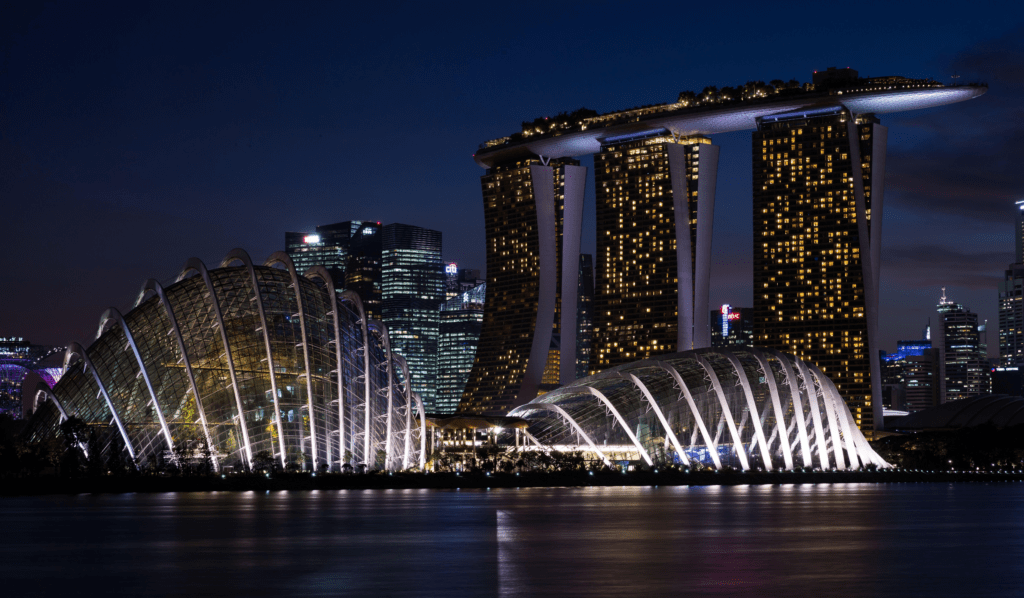
Directories now count more than 650 AI-native and AI-enabled companies in Singapore. Among the defining players:
- Grab — the super app for mobility, delivery, and finance is also one of the region’s largest AI adopters, using machine learning for demand forecasting, dynamic pricing, fraud detection, and route optimization.
- Sea Limited — the publicly listed internet group behind e-commerce (Shopee), fintech (SeaMoney), and the gaming arm Garena.
- A growing layer of specialized start-ups, from productivity and analytics tools to vertical solutions for retail, healthcare, and fintech.
Then there are the global heavyweights. At the ATxSummit 2026, Minister for Digital Development and Information Josephine Teo announced new partnerships with OpenAI, NVIDIA, and Google — a deliberate shift from experimentation toward real-world deployment. NVIDIA opened its first Singapore research hub in 2026, focused on embodied AI, having previously built AI-ready data-center infrastructure across the region with Singtel.
Physical AI and Infrastructure
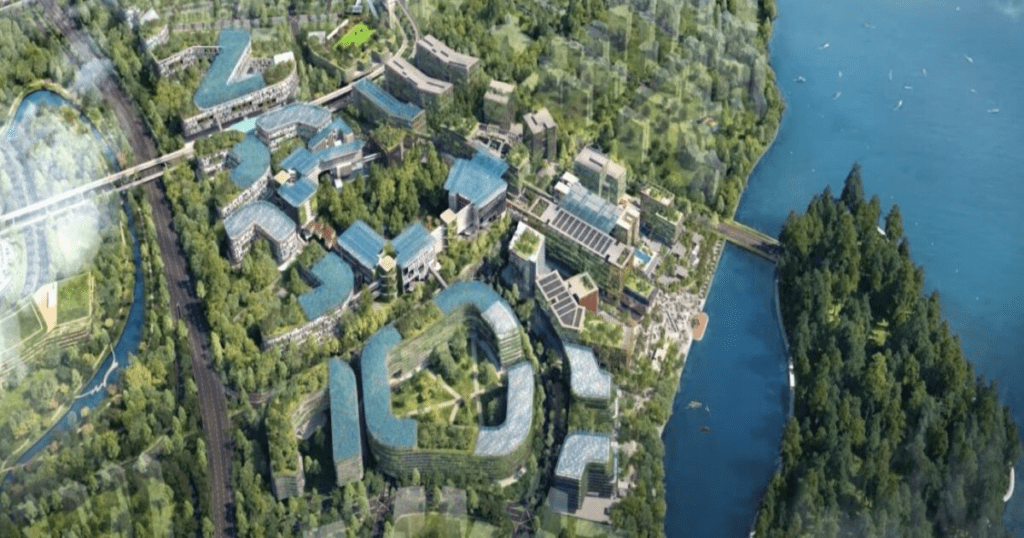
There is a growing emphasis on physical AI and robotics. At Punggol Digital District, Singapore’s first large-scale testbed for deploying autonomous systems in public spaces launches in 2026 — with companies such as Certis, DHL, Grab, and QuikBot trialing delivery, cleaning, and security robots. For embodied AI, the IMDA and the National Robotics Programme are working with partners including FieldAI, Thoughtworks, Slamtec, and Unitree.
The hardware base is exceptional: Singapore hosts one of the world’s densest data-center clusters, produces a significant share of global semiconductors, and operates a national supercomputer, ASPIRE 2A+, in the range of 20 PetaFLOPS.
The AI Community
What sets Singapore apart is the dense, well-connected community spanning research, industry, and grassroots.
Research & institutions: The universities NUS and NTU, the research agency A*STAR (for example, its Institute for Infocomm Research), plus SMU, SUTD, and SIT form the academic backbone. Through the national AI4S / AI4X (“AI for Science”) initiative, the National Research Foundation pairs AI researchers with domain experts — eight flagship projects launched in June 2026.
Flagship conferences: Singapore has positioned itself as neutral ground where Western and Asian AI ecosystems meet. These include ATxSummit / Asia Tech x Singapore, SuperAI, GITEX AI Asia (April 2026 at Marina Bay Sands), AI Engineer Singapore, the Singapore Vision Day at NUS, and the AI Symposium @ A*STAR.
Grassroots & meetups: At ground level, groups such as AI Tinkerers Singapore (builder demos, hackathons, infrastructure talks), the student-run AI+X Meetup, and KSUG.AI (Kubernetes, cloud-native, AI) drive the exchange — often backed by sponsors like AWS, NVIDIA, Oracle, or ElevenLabs.
Governance: Singapore is regarded as a pioneer of responsible AI. Its Model AI Governance Framework is continuously refined with input from more than 50 organizations — including AWS, DBS, Google, and Salesforce — and serves as a widely referenced global benchmark.
🎮 The Big Chapter: Singapore’s Gaming Industry
If Singapore punches above its weight in AI, it does so even more in games. The city-state is the preferred regional headquarters for global game companies, the host of major international esports tournaments, and home to a vibrant domestic studio scene. Estimates put around 180 to 220 game companies and roughly 30 esports firms active in the country. Despite its small population, Singapore posts above-average gaming revenue and the highest per-capita in-game spending among its Southeast Asian neighbors.
The Market in Context
Asia is by far the largest games market in the world, contributing roughly half of global revenue. Within the region, the SEA-6 (Indonesia, Malaysia, Philippines, Singapore, Thailand, Vietnam) form one of the fastest-growing sub-markets. Mobile games dominate with around 70% of Southeast Asian revenue — one reason Singapore is so attractive as an operational and publishing base. The small home market also forces local studios to think globally from day one.
The International AAA Studios
- Ubisoft Singapore is the largest and oldest foothold of a Western AAA publisher in the region. The studio spent years developing the naval technology behind Assassin’s Creed and led the pirate action game Skull and Bones (February 2024). Its lengthy, costly development — reportedly around US$200 million — also serves as a cautionary tale about the risks of long-running AAA projects.
- Nintendo Studios Singapore — arguably the most significant recent development. Nintendo acquired 80% of Bandai Namco Studios Singapore and renamed it Nintendo Studios Singapore effective 1 April 2026. What was previously Bandai Namco’s “leading development center” in Asia becomes a permanent part of Nintendo’s core development — a strong signal of Singapore’s standing as an AAA production location.
- Riot Games and Tencent run regional headquarters, steering operations, publishing, and esports for Southeast Asia from here.
- Nintendo had already established a dedicated local entity in September 2025 to expand its Southeast Asian presence.
- Other international studios and brands with a presence include Electronic Arts, Gameloft, PlayStation, 2K, Electric Square (co-development on titles such as Assassin’s Creed and Diablo IV), Virtuos (with around 1,500 staff worldwide, a leading provider of AAA 3D art and co-development), and the hardware specialist SteelSeries.
The Homegrown Studios
- Garena (part of Sea Limited) is the star of the local scene: its self-developed battle royale Free Fire ranks among the most-downloaded mobile games in its category, and Garena licenses and publishes international hits such as Call of Duty: Mobile and Arena of Valor in selected markets. Garena is also one of the world’s largest esports organizers.
- Mighty Bear Games, Battle Brew Productions, and The Gentlebros (known for the charming Cat Quest series) are among the most established independent studios.
- Daylight Studios (Holy Potatoes! series), Boomzap Entertainment, Massive Infinity, Inzen Studio, Deep Dive Studios (mobile, PC & VR), MAGES Studio (VR/AR and applied games), and Playware Studios (educational games, including work with the Ministry of Education) round out a diverse field.
Esports and Community

Singapore regularly hosts major international tournaments. Southeast Asia counts more than 200 million esports viewers, and the share of female gamers in Singapore is nearly on par with male gamers — an unusually broad-based market. Around 30 specialized esports firms, along with leagues and event organizers, form their own sub-ecosystem.
Government Support and Events
The government actively supports the sector through IMDA programs and talent initiatives, positioning Singapore as the region’s content and art-production hub. gamescom asia in Singapore has become a central industry gathering, underscoring the city-state’s ambition to be the gateway to the Southeast Asian games market.
Where AI and Games Converge
Singapore’s two strengths — AI and gaming — are increasingly merging. Studios experiment with AI-assisted content generation, procedural worlds, and smarter NPCs; platforms such as BUD are building AI-powered, user-generated 3D game worlds. With its data centers, talent pool, and funding landscape, Singapore is a natural place to push this convergence forward.
Outlook
Singapore’s model is deliberately twofold: commercial success paired with national strategic interest and responsible governance. Challenges remain — competition from larger neighbors, the pull of talent toward Silicon Valley, and questions of data sovereignty. But as neutral ground where global AI forces gather, and as an AAA-capable production location for games, the city-state is exceptionally well positioned to expand its role as Asia’s digital hub. To see how they are locally lifting up AI take a look here https://aisingapore.org/