
I have been running local models since the llama.cpp days when a 7B felt like a party trick. Qwen 3.8 27B is the first release that made me reopen my notes file and start planning hardware upgrades around it. Not because of a benchmark slide, but because of what it does on a normal day.
What the community actually found
The week this model dropped, r/LocalLLaMA looked like a Qwen fan convention. Half the front page was 27B posts. One developer reported wiring it into Codex as a drop-in replacement for GPT Luna, their usual workhorse, and finding it comparable for coding. The same team tested it on OCR pipelines and rated the quality above Gemini 3.5 Flash Lite, a model they pay real money for. That is the detail that should worry cloud providers: a free, local, 27-billion-parameter model out-reading the paid OCR tier of a major lab.
Another thread titled simply “Qwen 3.8 27B has the highest level of agency I’ve ever seen in a local model” described multi-step tool use that did not fall apart after two calls. Anyone who has tried agentic workflows on small local models knows the failure mode: the model forgets the goal, calls the wrong tool, or hallucinates a result and declares victory. A 27B holding a coherent plan across steps is new territory.
Then there is the code arena result. Qwen 3.8 27B landed in 9th position on the code arena leaderboard, ahead of far larger closed models, while Gemma 4 31B sat at 80th. Size is clearly not the whole story anymore. Architecture and training data quality have caught up with parameter count, and the sanction-constrained Chinese labs have gotten frighteningly good at both.
Why this one runs so well at home
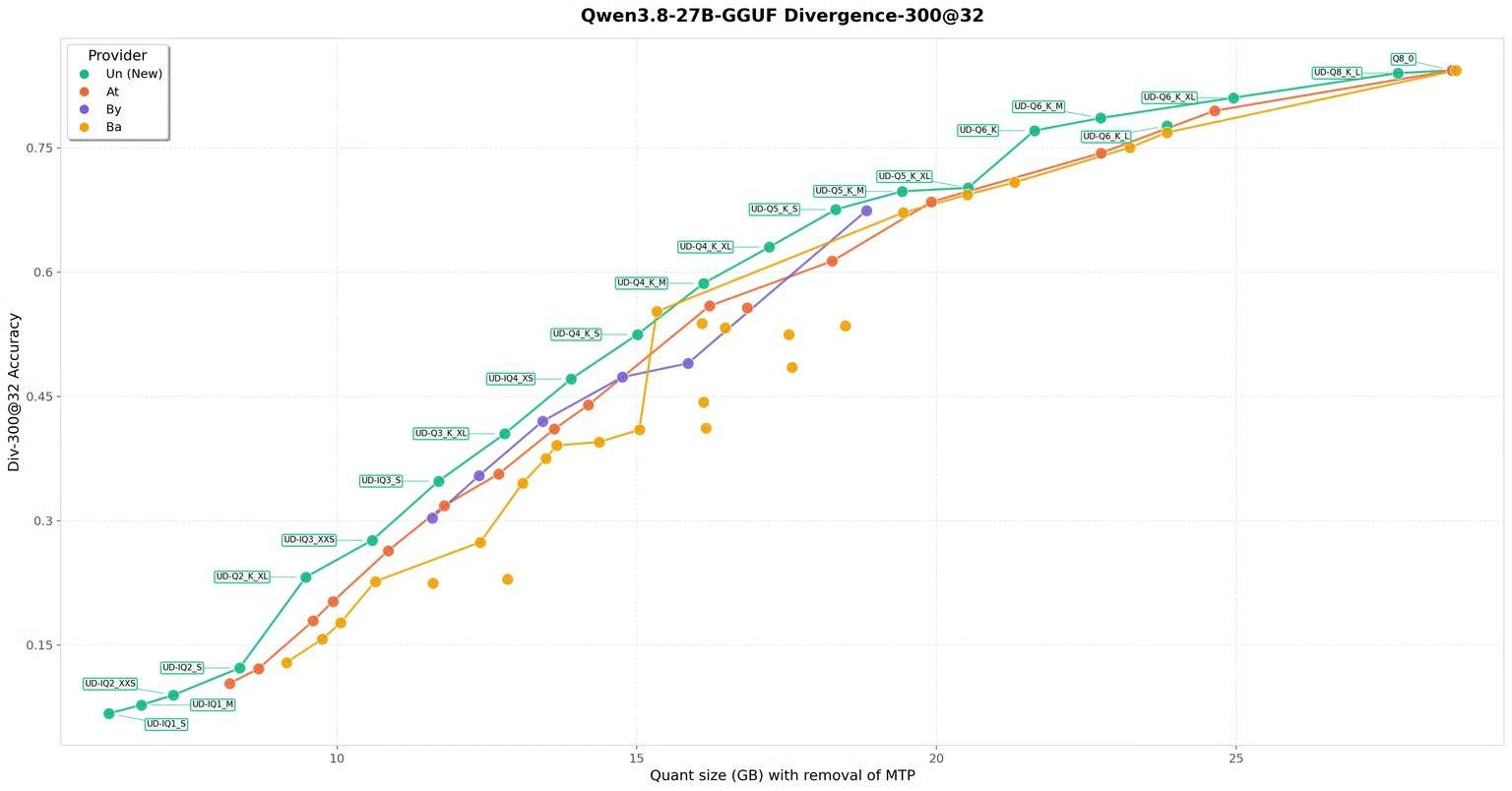
The interesting engineering story is the quantization scene around the release. Within days, the community shipped a 1-bit “brain damage” quant of the 27B that still runs usable inference, and Unsloth published dynamic v3 GGUFs tuned for consumer GPUs. A model that needs a datacenter rack in FP16 runs on a single 16GB card at Q4, and on 12GB cards at Q3, with quality loss most people cannot spot in casual use.
I run a 27B class model on a single GPU here, and it handles article drafting, translation chunks, and code review without the machine breaking a sweat. The math is simple. A Q4 quant of a 27B fits in roughly 16GB of VRAM. That is a used RTX 4090 or a new 5060 Ti 16GB. Two years ago that budget bought you a 7B that forgot the beginning of its own answer.
From brain damage quant to daily driver
The community quantization menu deserves its own section, because it is where the 27B story gets practical fast. The joke name of the week was the 1-bit “brain damage” quant, posted with benchmark screenshots that were funnier than they should have been. The punchline is that even that extreme compression still produced coherent answers, just noticeably degraded ones. Nobody should daily-drive it. Everybody should try it once, because it shows you where the floor is.
The serious options sit in the middle. Unsloth shipped their dynamic v3 GGUFs within days, which allocate precision dynamically across layers instead of uniformly. In practice that buys back most of the quality a static Q4 loses, at the same file size. Meanwhile the Q6 builds earned their own thread after users reported it “is a beast at agentic coding”, holding multi-file refactor plans without drifting. My rule of thumb after testing the family: Q6 if it fits, dynamic Q4 if it does not, Q3 only when the GPU leaves you no choice.
Context length is the quiet variable. A 27B at Q4 with a 32k context window fits in 16GB. Push the same build to 128k context and the KV cache alone eats several gigabytes more, which is how people end up confused about why a model that “fits” suddenly thrashes. If you run long documents or agents, budget VRAM for the cache the way you budget RAM for a browser with too many tabs.
The Flash-Next teaser nobody can ignore
While the 27B hype was peaking, Qwen dropped Flash-Next, a teaser for the next iteration of the smaller Flash line. The megathread pulled 300 votes and 276 comments in a day, which for a pre-release teaser is absurd. Early architecture notes suggest it is built to be even more local-friendly once weights land. Unsloth had day-0 support announced before the release date was even confirmed.
The pattern is clear. The gap between “frontier lab API” and “what fits on my desk” is now measured in months, not years. When the 27B already matches last year’s frontier models, the Flash line is the bet that the same quality lands at a fraction of the size and power draw.
What it means for gamers and home labs
If you play games and tinker with AI on the same machine, this release cycle matters more than any GPU marketing slide. Local inference shares your GPU with the game, so model size directly limits what you can run while a title is open. A 27B at Q4 that fits beside a game in 16GB means living NPCs, real-time translation mods, and AI game masters are no longer research projects. They are configuration files.
The economy argument is just as strong. The OCR developer I mentioned estimated that buying hardware to run the 27B locally would pay for itself in under two months of saved API bills. Hyper scalers built their moat on being the only ones with hardware. When the hardware requirement collapses to a single consumer GPU, that moat drains fast. One poster called it an IBM moment, the point where everyone assumed databases needed mainframes until cheaper local boxes ate the market. I think the comparison is more accurate than most people want to admit.
The week in context: it was not only Qwen
Zoom out from the Qwen flood and the week had two more stories worth knowing. The first was GLM-5.3-Flash, formerly known as ox-alpha, which got its own megathread and a warm reception as a fast assistant-tier model. The vibe in that thread was less “this changes everything” and more “finally, a good default for the second GPU slot”. In a hobby where everyone runs two or three models side by side, being the reliable cheap option is not a small compliment.
The second was DeepSeek V4 Flash Vision Experimental, an early vision-language build that previewed where the small multimodal class is heading. Experimental is the honest word there. People posted impressive document-understanding results next to outright failures on simple charts, which is about what you expect from a first export. The interesting part is the trajectory: vision used to be the thing you tolerated a big cloud model for, and it is migrating into the same 20-to-30GB envelope as everything else.
Stack those three together, Qwen for coding and agency, GLM for fast chat, DeepSeek for vision experiments, and a single 24GB card can now hold a complete little portfolio that covers most of what people paid API money for eighteen months ago. Nobody planned it this way. The labs are just shipping that fast, and the quant community is landing day-0 support before the announcement threads cool down. Unsloth had Flash-Next support lined up before the release date was even confirmed, which tells you how predictable this cadence has become.
The uncomfortable summary is that “which model should I run” is becoming a weekly question instead of a yearly one. That is good for anyone entering the hobby now and mildly exhausting for those of us maintaining benchmark notes. My advice is to pick one model per job, pin it, and only swap when something annoys you. Chasing every release is a full-time hobby in itself, and the differences between the current top three matter far less than having a setup that just works when you sit down to use it.
My take after a week with the family
I keep coming back to how boring the model is to operate, and I mean that as the highest compliment. No API keys, no rate limits, no invoice anxiety when a script loops. It generates at reading speed, holds context across long documents, and when it makes a mistake the mistake is legible, the kind you can debug instead of a cloud model just shrugging at you.
There is a real open question about whether the open source renaissance continues at this pace. Every previous wave, Llama 2, Mistral 7B, DeepSeek R1, eventually hit a wall where the next quality jump needed either more parameters or more money. Qwen 3.8 27B is evidence that the wall keeps moving. Whether Flash-Next is the one that walks through it, nobody knows yet. But for the first time I am not planning my setup around what the labs deign to release. I am planning it around what fits on my desk.
If you are sitting on a 16GB card and watching these threads from the sidelines, this is the release that justifies the upgrade you already wanted.

Frequently asked questions
What was the reaction of the r/LocalLLaMA community to Qwen 3.8 27B?
The r/LocalLLaMA community reacted enthusiastically; half of the front page posts were about Qwen 3.8 27B, indicating a significant interest and positive reception.
How does Qwen 3.8 27B perform in OCR pipelines compared to paid models?
The quality of Qwen 3.8 27B in OCR pipelines is rated above Gemini 3.5 Flash Lite, which is a paid model that users typically pay for, demonstrating its superior performance.
What does the release of Qwen 3.8 27B signify for hardware requirements?
The release signifies a significant reduction in hardware needs; it can run on a single consumer GPU with 16GB VRAM at quantization level Q4, making advanced AI capabilities accessible to more users.
Related reading
More on this topic: Is Qwen3 30b good? My experience and learning curve, LTX-2.5 vs MiniMax H3: two open video models that changed everything